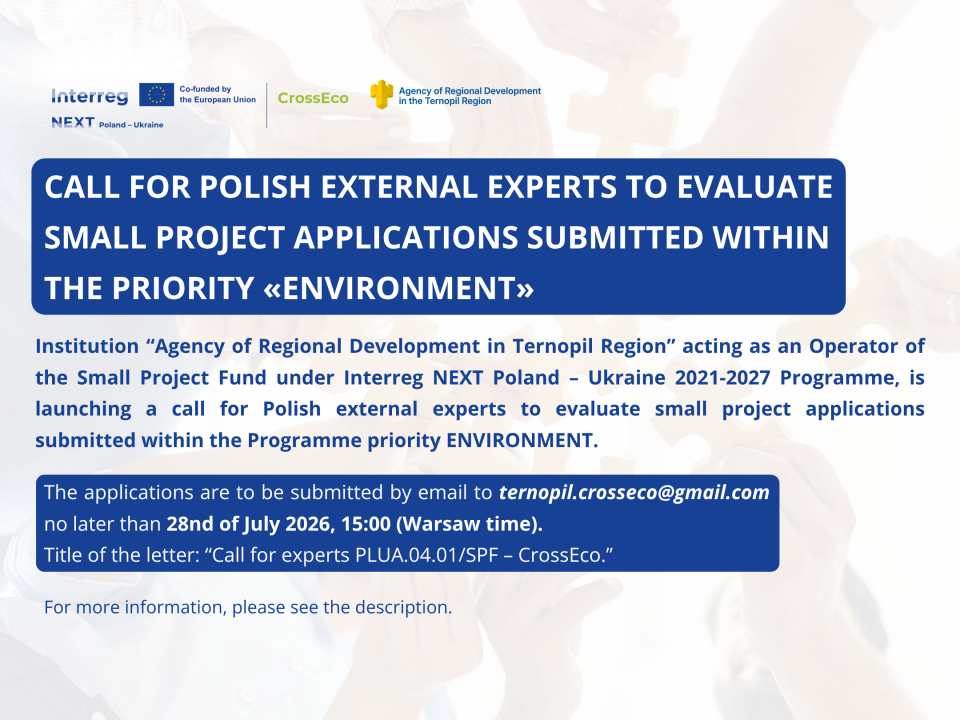

Competition to fill a vacant post to support the implementation of the Small Projects Fund under the “Environment” priority
22.06.2026
SUBMISSION DEADLINE EXTENDED FOR SPF UNDER THE “ENVIRONMENT” PRIORITY
23.06.2026
Budget preparation is one of the most important stages in drawing up a project proposal. During our consultations, we received numerous questions regarding expenditure, working with contractors, currency, infrastructure components and the specifics of lump-sum funding.
We have put together a list of the key points you should bear in mind before submitting your application.
Who plans and pays for the expenditure?
One of the main rules of the Programme is that the cost is borne by the partner in whose budget it is provided for.
It is this partner:
- carries out procurement;
- enters into a contract;
- makes the payment;
- is responsible for ensuring that the criteria for receiving the lump sum are met.
Is cross-border spending permitted?
The programme allows for the cross-border provision of services. A Polish partner may enter into a contract with a Ukrainian carrier or expert, whilst a Ukrainian partner may do so with a Polish service provider. At the same time, international payments are governed by the national legislation of the relevant country. We therefore recommend that matters relating to exchange controls, taxation, international transfers or the application of double taxation agreements be discussed in advance with your accountant and bank.
Is subcontracting between partners permitted?
Project partners may not act as contractors for one another, and contracts between beneficiaries of the same project are not permitted.
All services must be provided by independent third parties.
How does the lump-sum system work?
Under the Small Projects Fund, a lump-sum payment mechanism is used. This means that, when reporting, the focus is on the completion of the task, the achievement of results and indicators, rather than on each individual invoice. At the same time, for the purposes of any potential inspections and audits, the beneficiary must retain:
- contracts;
- invoices;
- handover certificates;
- payment documents;
- other supporting documents.
How is the cost of expenses determined?
If an item is listed in the Cost Catalogue (Annex 2), the price from the catalogue is used. If the item is not listed in the catalogue, its price must be confirmed:
- market analysis (at least three written quotations); or a cost estimate in accordance with national legislation.
Important! Documents for the valuation must be prepared no earlier than 6 months before the application is submitted.
VAT: a key difference between Ukraine and Poland
For Ukrainian beneficiaries, VAT is an unacceptable expense; therefore, amounts excluding VAT (net) are paid into the budget.
For Polish beneficiaries, VAT is a deductible expense.
How does the currency work in Generator?
The European Commission’s InforEuro exchange rate for the month in which the call for proposals is announced is used to draw up the budget.
Amounts are entered in hryvnias (UAH) or zlotys (PLN), and the Generator system automatically converts them into euros.
If the item is taken from the Cost Catalogue, it is already quoted in euros and does not need to be converted.
Important!
All future exchange rate risks during the implementation of the project are borne by the beneficiary. Before submitting your application, we recommend that you review each budget line item and ask yourself three questions:
- Is it related to the project’s objective?
- Is it necessary to achieve the result?
- Will I be able to confirm that it has been carried out by checking the criteria for receiving the lump sum?
It is precisely the logical link between the problem, objectives, tasks, indicators and budget that is one of the key factors in a successful project proposal.